

August 12, 2026
Aztec Software in 2026: A Practical Buying Workflow for SaaS Teams
Aztec software decisions are not just feature comparisons. Use this practical workflow to evaluate fit, integrations, reporting, rollout risk, and long-term operating value.
You do not buy Aztec software because a comparison table says it has the most features. You buy it because a real team has a workflow problem: people need to learn, track progress, manage users, report outcomes, and keep operations moving without turning software administration into a second job.
Teams think the problem is choosing the best platform. The real problem is deciding whether the platform fits the way work actually happens after rollout.
That changes the conversation. Instead of asking, “Is Aztec software good?” the practical question is, “Where will this software sit in our operating system, who owns it, what data needs to move, and what breaks if adoption is weak?”
In 2026, that matters more than ever. SaaS buyers have more tools, more integrations, more procurement pressure, and less tolerance for shelfware. This guide treats Aztec software as an architecture and workflow decision, not a definition exercise.
Table of contents
- Aztec software is a workflow decision, not a feature hunt
- Map the job before you compare Aztec software
- Build a practical evaluation scorecard
- Check implementation reality before signing
- Evaluate integrations as operating dependencies
- Measure reporting, outcomes, and accountability
- Understand pricing, contracts, and total cost
- Common failure modes with Aztec software rollouts
- A 30-day implementation sequence
- Where saasrow.com fits into the buying workflow
Aztec software is a workflow decision, not a feature hunt

The mistake teams make is starting with vendor pages, review snippets, and feature grids. Those inputs can help, but they are not the decision. They are raw material.
Aztec software may be evaluated for education, learning, workforce development, training, assessment, or productivity-related workflows depending on the buyer context. The exact use case matters. A small organization trying to improve learner progress tracking has a different buying problem than a larger team trying to standardize reporting across multiple locations.
What buyers usually get wrong
Many teams compare tools as if the winner is the product with the longest checklist. That approach looks objective, but it hides the actual cost.
A feature only matters if your team can operate it consistently. A dashboard only matters if someone reviews it. An integration only matters if it reduces work rather than creating another system to reconcile.
Practical rule: If a feature does not change a workflow, reduce manual work, improve visibility, or lower risk, treat it as optional until proven otherwise.
This is especially important for small business teams. They rarely have spare administrators. If a platform requires constant cleanup, manual exports, and user chasing, the tool may technically work while still failing operationally.
The operating question to answer first
Before comparing Aztec software to alternatives, write one sentence:
“Our organization needs this software to help [user group] complete [workflow] with [required outcome] while reducing [current pain].”
That sentence forces clarity. It separates business need from product enthusiasm. It also creates a standard for demos, pilots, implementation plans, and renewal conversations.
A useful way to think about it is this: the purchase is not the finish line. The purchase is the point where your workflow assumptions become real.
Where Aztec software may fit
Depending on your organization, Aztec software might sit near learning management, skills development, test preparation, assessment, reporting, or program administration. For SaaS buyers, the category label is less important than the operating role.
Ask where the platform will live:
- Is it the main workspace for learners or users?
- Is it an admin console for coordinators?
- Is it a reporting layer for managers?
- Is it one component inside a broader learning or productivity stack?
- Does it replace an existing tool, or add a new layer?
If you cannot answer those questions, you are not ready to evaluate demos seriously.
Map the job before you compare Aztec software
The strongest buying process starts before vendor outreach. You need a workflow map that describes the real job: intake, assignment, usage, support, reporting, and follow-up.
Teams think the problem is selecting software. The real problem is translating messy operations into a system that software can support.
Define the primary workflow
Start with the path a user follows from first touch to completed outcome. For example:
- User is identified or enrolled.
- User receives access.
- User completes initial activity or assessment.
- User follows assigned content or tasks.
- Admin monitors progress.
- Manager receives report.
- Team intervenes when progress stalls.
- Outcome is recorded.
This sequence is simple on purpose. Complexity comes later. If you cannot describe the workflow in plain language, a vendor demo will fill the gaps with assumptions.
For broader SaaS buying discipline, the same principle applies when teams research review platforms; a practical workflow for comparing tools is more useful than browsing ratings without context, as covered in this guide to software review sites.
Separate user jobs from admin jobs
Users care about clarity, speed, access, and progress. Admins care about setup, visibility, support, compliance, and reporting. Managers care about outcomes, costs, and accountability.
Do not collapse these into one generic “ease of use” score. A tool can be easy for end users and painful for administrators. It can also be powerful for reporting but confusing during daily use.
Create three columns:
| Role | Job they need done | Risk if ignored |
|---|---|---|
| End user | Access assigned work and see progress | Low adoption and support tickets |
| Admin | Configure users, groups, content, and exceptions | Operational drag and data errors |
| Manager | Understand performance and intervention needs | Poor decisions and weak accountability |
This table becomes a filter during demos. Ask vendors to show each role’s workflow, not just the cleanest product tour.
Document current failure points
Before looking at Aztec software, list where the current process breaks. Common examples include:
- Users do not know what to do next.
- Admins manually track progress in spreadsheets.
- Reports arrive too late to trigger action.
- Managers cannot compare groups or locations.
- Support questions repeat because setup is unclear.
- Data must be copied between tools.
What breaks in practice is rarely the big strategic goal. It is usually the handoff: enrollment to access, activity to reporting, report to intervention, or software output to management decision.
Build a practical evaluation scorecard
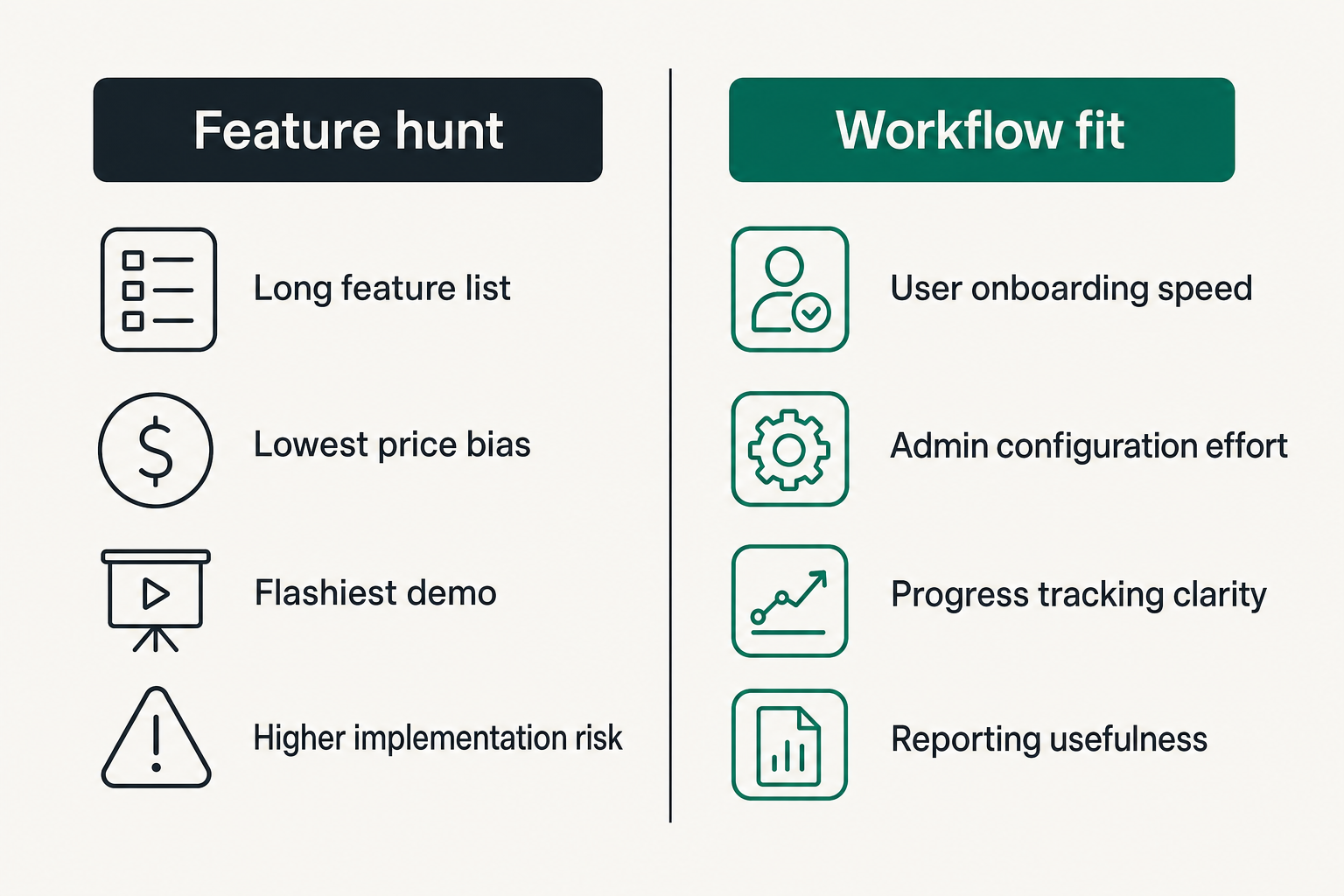
A scorecard keeps the buying process honest. It prevents the loudest stakeholder, flashiest demo, or lowest price from dominating the decision.
The scorecard should be short enough to use and specific enough to matter.
Score workflow fit before features
For Aztec software, workflow fit should carry more weight than feature depth. A platform that fits the daily operating model will usually outperform a more expansive platform that requires heavy process change.
Use criteria like:
- User onboarding speed
- Admin configuration effort
- Progress tracking clarity
- Reporting usefulness
- Integration or export quality
- Support model
- Contract flexibility
- Implementation risk
Practical rule: Score the software against the workflow you will actually run, not the workflow you wish your team had.
A realistic scorecard also exposes disagreement. If operations rates implementation risk as high while leadership rates the product as excellent, that is not a blocker by itself. It is a signal that rollout planning needs more detail.
Use weighted criteria
Not all criteria deserve equal weight. If reporting is the main reason for buying, reporting should count more. If adoption is the risk, user experience and onboarding should count more.
Here is a simple scoring model:
| Criteria | Weight | What to inspect |
|---|---|---|
| Workflow fit | 30% | Can the tool support the real process without workarounds? |
| Reporting | 20% | Are reports actionable for the people who need them? |
| Administration | 15% | Can the team maintain users, roles, and changes? |
| Integrations | 15% | Can data move cleanly to other systems? |
| Support | 10% | Is help available at the level your team needs? |
| Commercial terms | 10% | Does pricing match usage and risk? |
This does not need to be fancy. A shared spreadsheet is enough. The discipline matters more than the format.
Compare alternatives honestly
Aztec software should be compared against the realistic alternatives: current process, adjacent tools, broader platforms, and lighter-weight systems.
The current process is an alternative even if nobody likes it. If the current process is cheap but chaotic, quantify the chaos: manual hours, late reports, missed follow-ups, duplicated data entry, or manager confusion.
Related reading from our network: teams selling physical products face a similar system-design issue where the storefront is only one piece of repeatable operations, as explained in this guide to selling products online with a shipping system.
Check implementation reality before signing
A clean demo hides setup work. Implementation is where SaaS buying gets real.
The practical question is not, “Can the platform do this?” It is, “Can our team get this live without breaking existing operations?”
Data migration and setup
Make a setup inventory before contract signature:
- User lists
- Groups or cohorts
- Locations or departments
- Admin roles
- Existing progress records
- Content assignments
- Reporting requirements
- Historical data needs
Then ask what must be migrated, what can be archived, and what should be started fresh. Many teams over-migrate because they are afraid to lose history. That creates messy data in the new system.
A better approach is to define minimum viable history. What historical data is required for reporting, compliance, user continuity, or management review? Move that. Archive the rest.
Roles, permissions, and ownership
Permissions are not just a security detail. They define how work flows.
If every admin has full access, mistakes spread. If permissions are too restricted, routine changes require escalation. If ownership is unclear, users wait while teams debate who should fix access problems.
Create a role map:
| Role | Can configure users | Can view reports | Can change content | Can export data |
|---|---|---|---|---|
| System owner | Yes | Yes | Yes | Yes |
| Program admin | Yes | Yes | Limited | Limited |
| Manager | No | Yes | No | No |
| Support user | Limited | Limited | No | No |
This is not bureaucracy. It is a way to prevent the platform from becoming dependent on one person who knows where everything lives.
Training and adoption path
Training should be role-based and short. Do not run one generic session for everyone unless the workflow is truly simple.
End users need to know how to log in, what to do next, where to see progress, and how to get help. Admins need to know how to manage exceptions. Managers need to know how to read reports and trigger action.
The mistake teams make is treating training as a launch event. Training is part of the operating system. It needs reinforcement, especially after the first few weeks when edge cases appear.
Evaluate integrations as operating dependencies
Integrations are where software buying becomes architecture. Aztec software may not need a complex integration stack for every team, but every buyer should know which systems must share data.
A weak integration plan turns a promising platform into another silo.
Identify systems of record
Every important data type should have a system of record. That means one place is trusted as the source.
Examples:
- User identity may live in HR, SIS, CRM, or an admin spreadsheet.
- Progress data may live in Aztec software.
- Outcome reporting may live in a BI tool or management dashboard.
- Billing or contract data may live in finance systems.
If two systems both claim to be the source of truth, reconciliation becomes a recurring tax.
Practical rule: Before launch, decide which system owns each data field. If ownership is unclear, the integration will eventually become a spreadsheet problem.
Plan handoffs and exports
Not every integration needs to be real-time. For many small teams, scheduled exports or structured reports are enough. The key is consistency.
Define the handoff:
- What data moves?
- In what format?
- How often?
- Who checks it?
- What happens when it fails?
If the platform offers APIs, ask about documentation, rate limits, authentication, and available endpoints. If exports are the main path, inspect field names, filters, and whether the output matches the reporting workflow.
Watch for manual reconciliation
Manual reconciliation is not always bad. Sometimes it is acceptable during a pilot. But if the long-term operating model depends on copying data between systems, be honest about the cost.
This is where productivity tools either help or hurt. A tool that centralizes work can save time. A tool that requires parallel tracking can add hidden labor.
The same concern appears in project management comparisons. When teams compare platforms like monday.com and ClickUp, the real issue is often ownership, automation, and reporting across workflows, not just task boards; that is the angle in this monday.com vs ClickUp workflow guide.
Measure reporting, outcomes, and accountability
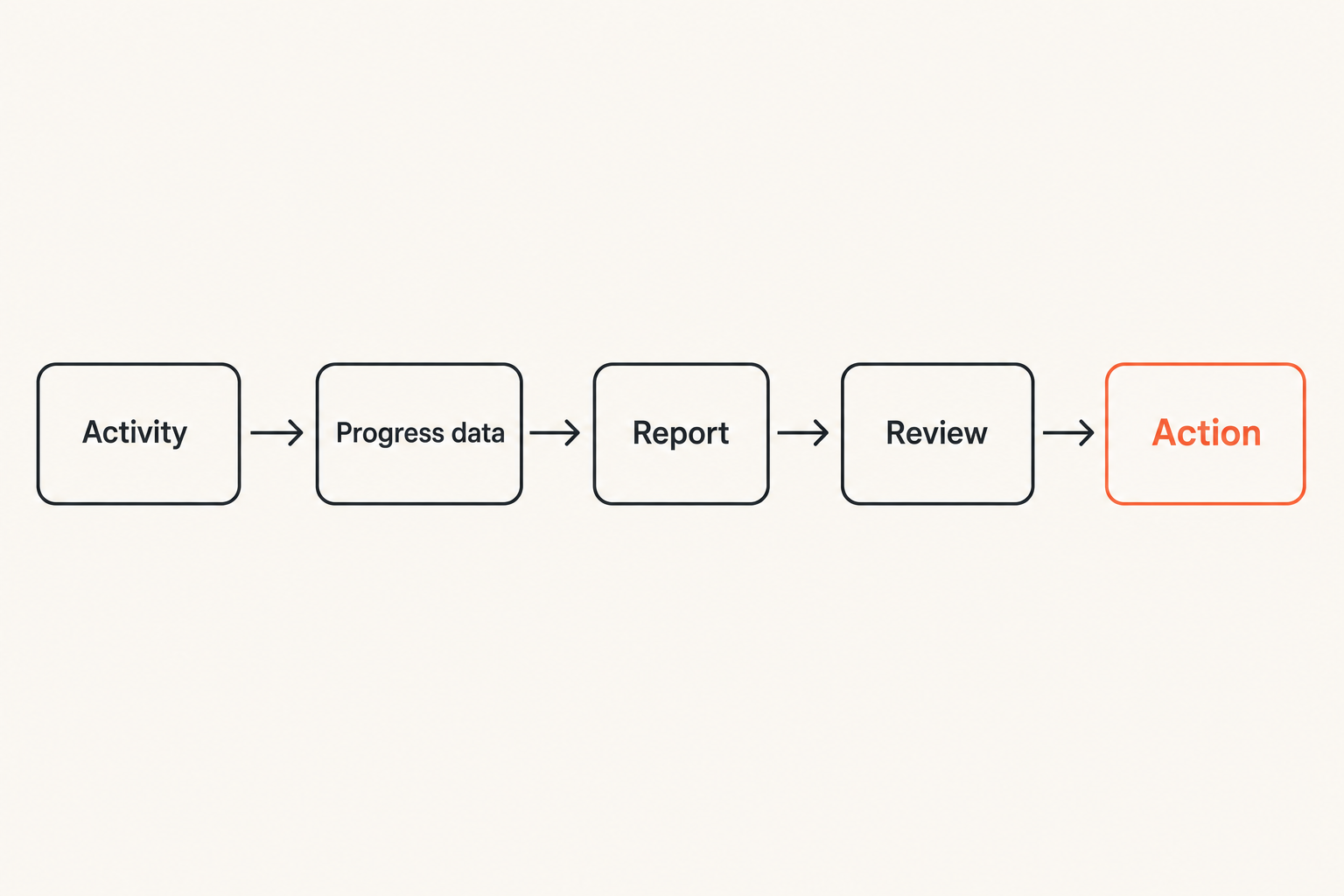
Reporting is often sold as a product feature, but it is really a management workflow. A report has value only if someone uses it to make a decision.
For Aztec software, reporting may include progress, activity, completion, assessment outcomes, group comparisons, or intervention signals. The exact metrics depend on the use case, but the operating principle is the same.
Know who needs reports
Different stakeholders need different reporting views.
| Stakeholder | Report need | Decision supported |
|---|---|---|
| Admin | User progress and exceptions | Who needs help or configuration changes? |
| Manager | Group outcomes and trends | Where should resources go? |
| Executive | High-level performance | Is the program working? |
| Support | Access and usage issues | Who is stuck and why? |
Do not overload every stakeholder with every metric. More dashboard fields often create less action.
Avoid vanity dashboards
A vanity dashboard shows activity without decision context. Logins, clicks, or minutes may matter, but only if they connect to progress, completion, skill gain, compliance, or another meaningful outcome.
Ask this for every metric: “If this number changes, what action will we take?”
If there is no answer, the metric is probably informational, not operational.
What works:
- Reports tied to intervention rules
- Simple exception lists
- Cohort or location comparisons
- Trend views reviewed on a schedule
- Exportable data for required reporting
What fails:
- Dashboards nobody owns
- Metrics that look impressive but do not trigger action
- Manual reporting that depends on one admin
- Reports delivered after the decision window has passed
Design a review cadence
Reporting needs rhythm. Decide whether reviews happen weekly, monthly, quarterly, or around program milestones.
A lightweight cadence might look like this:
- Admin reviews stuck users every Monday.
- Manager reviews group progress every two weeks.
- Leadership reviews outcome trends monthly.
- System owner reviews data quality and support issues monthly.
That cadence turns reporting from passive visibility into an operating habit.
Understand pricing, contracts, and total cost
The list price is only one part of the cost. The total cost of Aztec software includes licenses, setup, administration, training, support, integration work, reporting labor, and switching risk.
Procurement should not reduce the decision to “which vendor is cheapest?” Cheap shelfware is expensive.
Look beyond license cost
Ask vendors to clarify:
- Per-user pricing rules
- Active versus registered user definitions
- Minimum commitments
- Setup fees
- Support tiers
- Renewal increases
- Contract length
- Cancellation terms
- Data export rights
Small teams should pay special attention to minimums. A tool can look affordable per user while still requiring a commitment larger than the team can absorb.
Model support and administration
Administration time is a real cost. Estimate how many hours per month the team will spend on:
- Adding and removing users
- Handling access issues
- Updating groups or assignments
- Running reports
- Cleaning data
- Supporting managers
- Reviewing vendor updates
Even if the software saves time overall, you need to know where the remaining work goes. Otherwise, the system quietly overloads an operations person.
Negotiate around risk
Negotiation should focus on reducing implementation and renewal risk, not just discounting.
Useful contract asks include:
- Pilot period with clear success criteria
- Implementation support included
- Data export access
- Flexible user ramp
- Renewal notice window
- Documented support response expectations
- Clear termination process
That changes the conversation with vendors. You are not just asking for a lower price. You are asking for a structure that matches adoption reality.
Common failure modes with Aztec software rollouts
Bad rollouts usually follow predictable patterns. The product may not be the problem. The operating model is.
The mistake teams make is blaming users for low adoption before inspecting whether the workflow was designed well enough to adopt.
The pilot that proves nothing
A pilot without success criteria is just a temporary login.
A useful pilot should define:
- Who participates
- What workflow is tested
- What data is reviewed
- What support issues are tracked
- What outcome qualifies as success
- What decision will be made after the pilot
If the pilot includes only enthusiastic users, it may not expose real friction. Include at least a few normal users and administrators who will operate the system after launch.
The integration gap
The integration gap appears when everyone assumes data will move cleanly, but nobody tests the handoff. Then launch arrives, reports do not match, users are duplicated, or managers ask for fields that are not available.
Related reading from our network: the same ownership and validation problem shows up in software supply chains, where teams need clear control points rather than vague confidence; see this CI/CD security system installation guide.
To avoid the gap, test real data before go-live. Do not rely only on sample data in a demo environment.
The orphaned owner problem
Every SaaS tool needs an owner. Not a fan. Not a buyer. An owner.
The owner is responsible for:
- Vendor relationship
- Configuration decisions
- Internal documentation
- Reporting cadence
- Support escalation
- Renewal review
- Adoption monitoring
If nobody owns Aztec software after purchase, the platform becomes background noise. Users drift, reports stop being reviewed, and renewal becomes a rushed decision based on incomplete evidence.
A 30-day implementation sequence
A lightweight sequence helps teams move from decision to operating reality. Adjust the timeline for complexity, but keep the order.
Week 1: clarify scope
During the first week, lock the operating basics:
- Confirm the primary workflow.
- Name the system owner.
- Define user groups and admin roles.
- Identify required reports.
- Decide what data must be migrated.
- Document success criteria.
Do not start configuration before scope is clear. Otherwise, the system gets shaped by whoever clicks fastest in setup.
Week 2: configure and test
In week two, configure the platform and test with real scenarios.
Use a test script:
- Create a user.
- Assign the correct content or workflow.
- Complete a representative activity.
- Trigger progress tracking.
- Generate a report.
- Export or share data.
- Simulate a support issue.
- Remove or deactivate a user.
This reveals friction before it hits the full team.
Related reading from our network: permissioned access and recovery workflows matter in remote collaboration too, which is why this remote control workflow article is a useful adjacent read for teams thinking about handoffs and control.
Weeks 3 and 4: launch and inspect
Launch should be narrow enough to manage and broad enough to test reality.
During the first two weeks after launch, inspect:
- Login issues
- Assignment confusion
- Admin workload
- Report accuracy
- User completion patterns
- Support ticket themes
- Manager feedback
Hold a launch review at the end of week four. Decide what to change, what to document, and whether the rollout should expand.
If your team also manages people coverage or shift-based operations, the same rollout discipline applies when choosing tools such as scheduling software; workflow fit and payroll handoff matter more than surface-level feature volume, as covered in this staff scheduling software guide.
Where saasrow.com fits into the buying workflow
SaaS buying has become noisy. Review sites, vendor pages, analyst-style grids, and social posts all compete for attention. The problem is not lack of information. The problem is turning information into a decision your team can operate.
That is where a practical software research habit helps.
Use software content as decision support
Good software content should help you ask better questions. It should not make the decision for you.
When reading about Aztec software or any other SaaS platform, look for content that helps you inspect:
- Workflow fit
- Implementation effort
- Reporting quality
- Integration dependencies
- Support needs
- Ownership model
- Renewal risk
Avoid content that only repeats feature lists. Feature lists are useful inputs, but they are not an operating plan.
Keep the buyer workflow repeatable
The real advantage is not making one good purchase. It is building a repeatable buying workflow your team can use again.
A simple repeatable workflow looks like this:
- Define the job to be done.
- Map the current workflow.
- Identify failure points.
- Build weighted criteria.
- Compare realistic alternatives.
- Test implementation assumptions.
- Launch with ownership and review cadence.
- Revisit the decision before renewal.
Use that pattern for Aztec software, project management software, scheduling tools, CRM systems, analytics platforms, and almost every other SaaS decision. The category changes. The operating discipline does not.
Aztec software should be judged by whether it improves the work: clearer access, better progress visibility, cleaner reporting, less manual administration, and stronger accountability. If it does that for your team, the product is creating operational value. If it does not, more features will not fix the buying process.
Try saasrow.com
saasrow.com is for readers who want practical articles, guides, and insights about software and productivity. Use it to compare tools, improve workflows, and choose software more deliberately: Try saasrow.com.